
What Russell County Deed Records Contain
In Russell County, the County Clerk records deeds, mortgages, liens, releases, and plats. Each instrument names the parties and its type. It also carries the filing date and book/page reference. Legal descriptions vary. Some rely on acreage and adjoining owners, while others use a survey or a recorded plat. A recorded deed beats the PVA tax roll as ownership evidence, but the index is only a finding aid, so the full record still has to be read.
| Recorded instrument | Effect shown in the record | Russell County research use |
|---|---|---|
| Warranty deed | Conveys the stated interest with deed warranties | Ordinary purchase and sale trail |
| Special warranty deed | Limits warranties to the grantor's period or acts | Read the warranty language and prior chain |
| Quitclaim deed | Conveys whatever interest the grantor may hold | Name, family, or interest cleanup |
| Executor, trustee, or commissioner deed | Transfers under a stated fiduciary or court authority | Branch to probate, trust, or court file |
| Correction or confirmation deed | Repairs or confirms a prior recorded instrument | Compare both legal descriptions and references |
Not every instrument conveys ownership. A mortgage, judgment lien, easement, or restrictive covenant burdens an interest. It shapes that interest instead of transferring it. Kentucky's recording framework comes from KRS Chapter 382. Priority, validity, and title effects still turn on the instrument and the facts behind it. A careful Russell County deed review follows the whole trail. Releases, amendments, assignments, and corrections matter as much as the first matching name.
Why Russell County Deeds Do Not Start with an Address
The eCCLIX land-record search does not accept street addresses. It also does not take a tax lot as its key. Names come first. That makes the Russell County PVA card in qPublic the practical bridge. Copy the Current Owner name and deed book/page exactly. Then carry those facts into the clerk's index. That beats guessing which person or tract a broad surname result represents.
qPublic cards also show why that reference matters. Russell County map records cite books and pages such as 148/307, 349/339, and 303/743. Map, account, PID, and PTID identifiers sit alongside them. Those numbers serve assessment and tax systems well. But eCCLIX stays centered on party names and recording metadata.
Fields Used to Search Russell County Deed Records
The online clerk route is eCCLIX, an account-based index and image service. Access depends on the account's rights. The county's exact online start date is not published. An empty online result means asking the clerk, not concluding that no deed exists.
| Index field | Best input | Use or limit |
|---|---|---|
| Grantor or party | Seller, estate, trustee, or entity name | Find the party conveying an interest |
| Grantee or party | Buyer or recipient name | Find an acquisition deed |
| Book/type and page | Reference copied from PVA or another deed | Targets a known instrument |
| Instrument number | Exact number from a notice or closing file | Useful when the filing supplies it |
| Recording date | Narrow date or range | Reduces same-name results |
| Address or tax lot | Not available | Use PVA first to obtain the name and deed reference |
The captured eCCLIX login page shows the account gate before county index access.
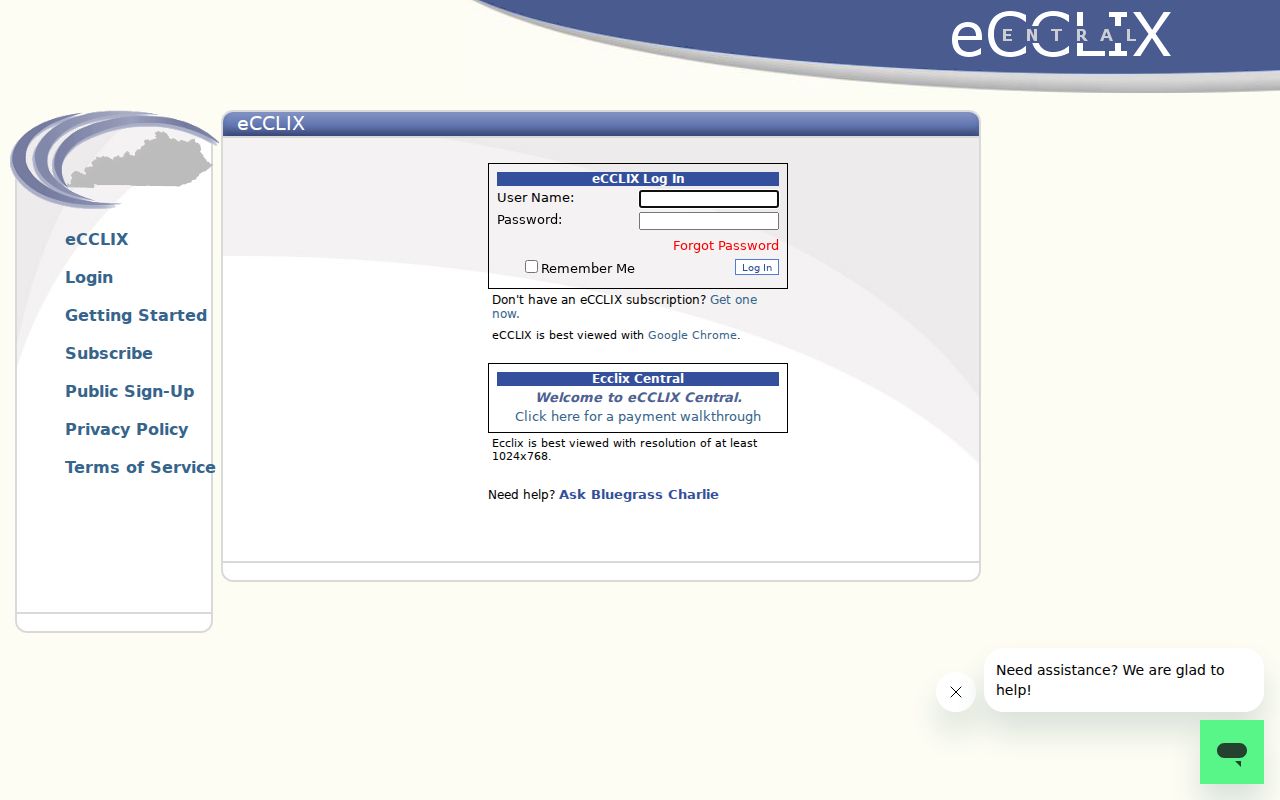
The login screen itself yields no deed results. A searcher still needs the correct county, proper account rights, and the right index terms before any image can be opened.
Online Images and the Russell County Access Gate
eCCLIX sells paid plans and also offers limited public accounts. County selection is built into registration. The vendor publishes its own prices. Those are not Russell County Clerk copy charges, and they can change. Public accounts face limited access hours, a daily search quota, and possible distance-based restrictions. The eCCLIX subscription form displays the county and plan selections a registrant can choose. The courthouse counter remains the equal-access route.
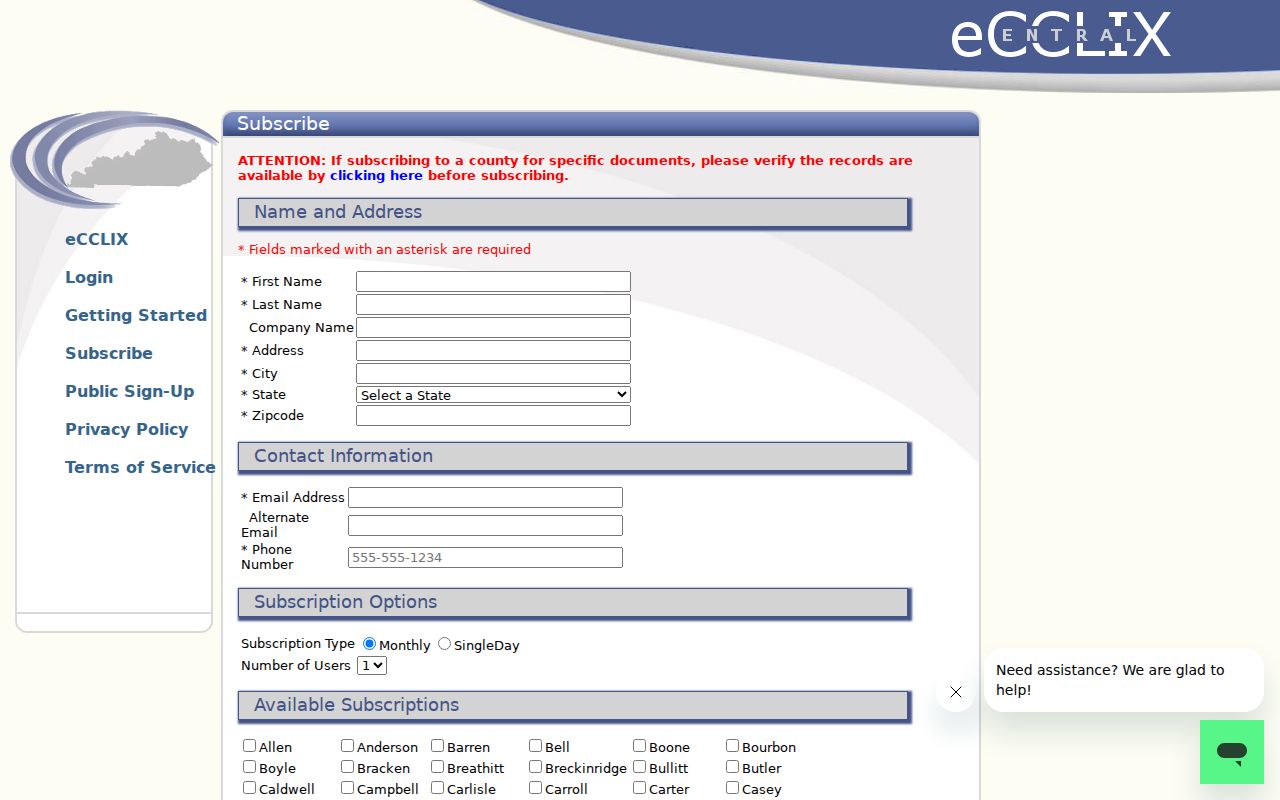
The subscription form governs vendor access only. Certification is separate, so a certified deed must still come from the Russell County Clerk under the clerk's current copy and certification procedures.
Walk the Russell County Grantor-Grantee Index
A grantor-grantee index sorts transfers by who gave and who received the interest. Start with the newest deed you can verify. Each grantor becomes the next historical lead. Keep the parcel description beside the name search, because one person may have conveyed several tracts in Russell County.
- Open the PVA card and record the current owner, deed book/page, map number, acreage or lot, and location.
- Pull that deed and record every grantor, grantee, deed type, recording date, reference, and legal description.
- Search the grantor as an earlier grantee, trying initials, spelling variants, estate captions, and entity punctuation.
- Compare the earlier legal description, acreage, lot, plat, adjoining owners, and easements before accepting the match.
- Repeat until the target date, then shift to clerk books, KDLA, FamilySearch, or parent-county research as needed.
- Grantor
- The party conveying the stated interest.
- Grantee
- The party receiving the stated interest.
- Chain of title
- The linked sequence of conveyances affecting the same land.
- Book/page and instrument number
- Different filing keys used to retrieve a recorded document.
The 1825 Edge in Russell County Deed History
The KDLA county table lists Russell deed coverage from 1825 through 2015. Its formation chart dates the county to 1826, carved from Adair, Cumberland, and Wayne. That one-year edge is a research question. It proves neither a missing book nor destroyed records. Early Russell County deeds deserve a check against the actual volume, the index, and the original filing context. A list date is only a starting point.
KDLA's land-record guide adds a key rule. Records stay in the county where they were first filed, even after boundaries move. A chain reaching before 1826 may branch outward. Parent counties and state land-patent sources become part of the trail. Later local context helps too. Russell County Public Library's searchable newspapers cover Russell County News from 1939 through 2003 and Times Journal from 1949 through 2006. A newspaper notice is a clue, not proof.
At the earliest edge, inspect the general index and the deed book itself. Note the jurisdiction named in the instrument. Compare the tract description against parent-county entries. KDLA requests and FamilySearch catalog leads can locate old volumes, but confirm image access with the clerk before treating a missing web result as a gap. Keep a citation for every volume, page, index entry, spelling variant, and county so the route can be retraced at the counter.
No Russell County Deed Alert Was Verified
Russell County offers no verified property-fraud alert enrollment through the clerk or county sources. Sending owners to an unverified signup would be worse than none. Call the Russell County Clerk at 270-343-2125 to ask whether an alert has been added since, and how the office suggests monitoring new deed filings.
Check the source. A mailer that demands payment for a deed should be compared with the clerk's official contact and recording reference before any money is sent.
Request a Russell County Deed Copy
Start with the online image if your account rights allow it. Otherwise contact the Russell County Clerk at 410 Monument Square, Suite 106, Jamestown. By phone, ask three things. Is the instrument indexed? Is the image online? What does a plain or certified copy cost today? The clerk sets no posted Russell deed or plat fee. So confirm the charge and counter hours before you drive over.
At the counter, ask about the public terminal and deed books. Ask also about older general indexes, plat cabinets, and certification. A written Kentucky Open Records Act request should name the instrument and book and page. Include the parties, or a narrow date range. State plainly whether you want inspection, an electronic copy, a plain copy, or a certified copy. The Act draws one firm line. It never obliges the clerk to build a title search or legal opinion for you.
Older Russell County deed records live elsewhere. Use KDLA records requests. You can also try the clerk's older books, FamilySearch catalog leads, or the local library. FamilySearch requires a login and limits some images. Exact Russell image coverage also varies, so check before relying on it.
Recorded does not mean clear title. Russell County deed records show accepted filings, not a legal opinion on ownership, priority, boundaries, or unrecorded interests.