
Trace Russell County Former Owners Through Each Transfer
Work backward from the current Russell County PVA parcel card. The card lists a book and page for the newest deed. That card is only a bridge. It points to the latest instrument held by the Russell County Clerk. Once the deed is read, its grantor becomes the next former owner to chase through earlier deed records.
| Source | Verified span | Where held | Ownership clue |
|---|---|---|---|
| Current PVA parcel card | Current roll snapshot; online cutoff unstated | Russell PVA and qPublic | Current Owner, deed book/page, map number, sales leads |
| Recorded deed index and images | Russell-specific online start not confirmed | County Clerk and eCCLIX | Grantor, grantee, instrument, date, book/page and description |
| Archival Russell deed series | 1825-2015 in the KDLA county table | Clerk books and KDLA finding aids | Earlier conveyances and permanent index references |
| Will and order books | Wills 1826-2015; orders 1826-2001 | Court, clerk and KDLA routes | Estate authority, heirs, fiduciaries and court-directed transfers |
Pick the right starting point. For a recent transfer, begin with qPublic and the newest recorded deed. Older questions need a name and year. Ask the clerk or the Kentucky Department for Libraries and Archives for the proper index volume, because the archival span does not put every older deed image online.
Book and Page Clues Find Russell County Former Owners
Reproduced Russell qPublic cards show the handoff clearly. Sample deed references include 148/307, 349/339, and 303/743. Those numbers are steadier keys than a street address. eCCLIX does not support deed searches by address or tax lot. Preserve the reference exactly. Search the PVA first, then carry the citation to the clerk's index or counter.
Copy every field. A good extraction records all grantors and grantees, deed type, execution and recording dates, consideration, book and page, and the full legal description. Prior-owner searches fail when only one surname is noted. Married names, initials, estate captions, trustee capacity, and LLC punctuation vary between instruments.
The eCCLIX login page displays the account gate that guards the hosted county index.
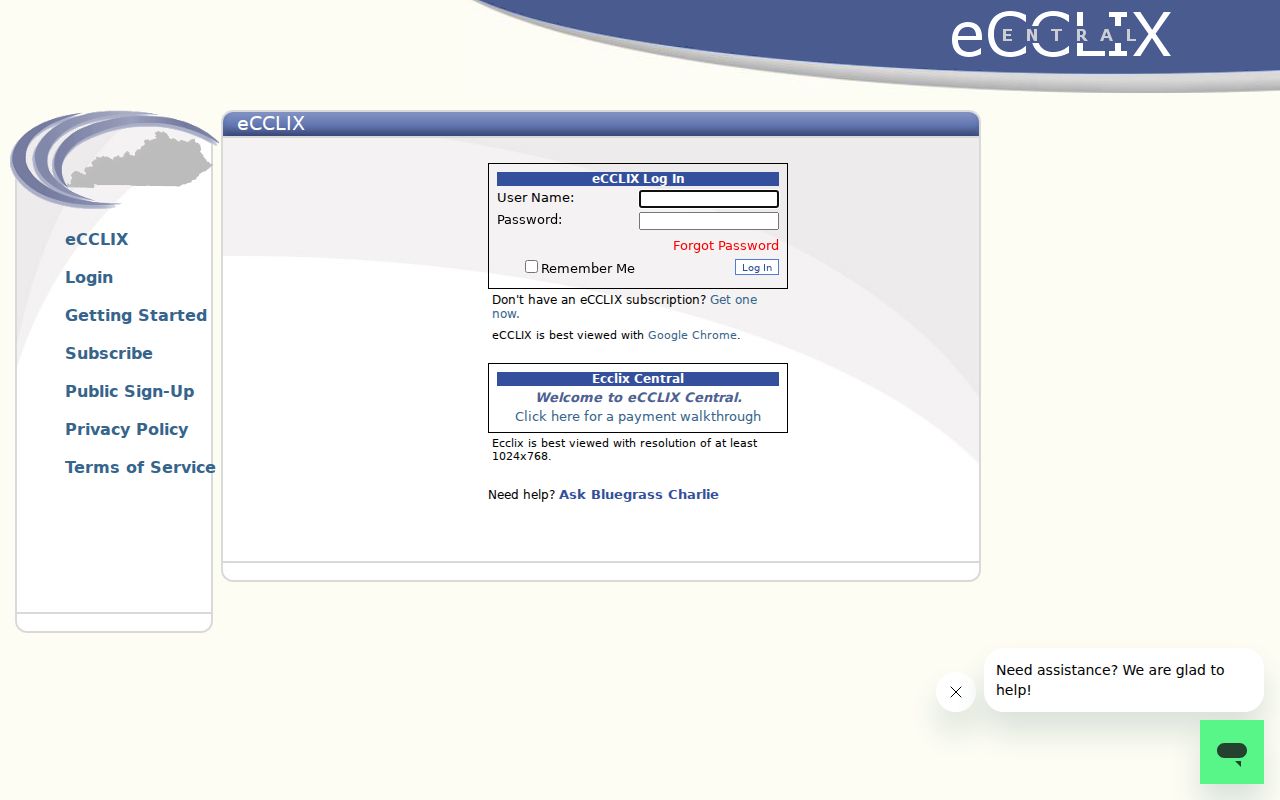
The online route runs through an account gate. The login itself is just a door. It reveals nothing about Russell County's earliest searchable date or the depth of online deed image coverage.
Note: A qPublic sales row can guide the search, but it is not a complete list of Russell County former owners.
Read Russell County Former Owners in Reverse
Reconstruct transfers, not just names. That grantor on the newest deed is the former owner. Next, locate the deed where that same person appeared as grantee. Repeat the step. Continue while the description, parcel, or parent tract stays consistent through the Russell County deed records.
- Use the Russell qPublic search to capture the current owner, map number, description, and deed reference.
- Retrieve the latest deed through eCCLIX or at the county clerk counter and identify every grantor.
- Search each grantor as an earlier grantee, allowing for initials, alternate spellings, trusts, estates, and business entities.
- Compare acreage, lots, adjoining-owner calls, plat references, and prior book/page citations before accepting the match.
- Continue into deed books or archive material when the hosted index no longer reaches the needed year.
- Grantor
- The party who conveyed an interest in a deed.
- Grantee
- The party who received the conveyed interest.
- Reverse index
- An index organized to find conveyances through a grantor or grantee name.
- Chain of title
- The linked sequence of instruments affecting the same land; a researched chain is not itself a legal title opinion.
Legal Descriptions Test Russell County Prior Owners
A shared surname proves nothing. Two deeds may concern different land entirely. Compare the legal description at each step. Russell descriptions may cite acreage, lot and phase, map number, road, adjoining landowners, a plat, or an earlier deed reference. Tracts shrink after splits. They grow after consolidation or shift under a correction deed.
Lot 247, Stillwater Subdivision, Phase II, offers a local example. It covers .61 acre, map 076-20-01-247.00. The public notice gives a strong parcel lead but no plat book or cabinet reference. Request the recorded plat next, and compare the lot, phase, easements, restrictions, and association documents against the deeds.
Note: Preserve leading zeroes, hyphens, and decimal suffixes in Russell map numbers; PID, PTID, account, and map number are separate identifiers.
Estate Deeds Complicate Russell County Former Owners
Not every owner fits a neat buyer-to-seller line. A death can lead to a will, probate order, survivorship instrument, fiduciary deed, or a later beneficiary conveyance. KDLA lists Russell will books from 1826 through 2015. When a deed names an estate, executor, administrator, trustee, or devisee, search CourtNet and ask the Russell Circuit Clerk for the probate file.
Foreclosures need the court thread too. So do master-commissioner sales. A notice may supply a map number and a civil action number, but the notice is only a lead. Pull the whole court file. The file holds the judgment, sale confirmation, commissioner report, deed, and any releases. Russell notices expressly warn that a commissioner deed is no warranty of good title.
Chain break: A death certificate shows an event, not a conveyance. Find the deed, survivorship document, will, or court order that moved title.
Russell County Former Owners Reach an 1825 Archive Edge
The official KDLA county records table lists Russell deeds from 1825 through 2015. Russell County formed in 1826. Its parents were Adair, Cumberland, and Wayne counties. That 1825 edge is strange. It is a research question, not proof of missing records or a courthouse disaster. Russell has no documented courthouse fire or loss event.
A chain reaching past 1826 may cross into a parent county. It may also climb into state land-patent sources. KDLA's land-record guide keeps records in the county where they were first filed, even after boundary changes, so identify the description and date before choosing a parent-county branch. The eCCLIX cutoff and image coverage stay unpublished. State the archival series range separately from whatever a paid or public account displays.
Older Russell County Former Owners May Be Offline
Once the online index runs out, gather your details. Take the party name, the date range, the instrument type, and any book/page reference to the Russell County Clerk. Ask whether the deed book or general index you need sits at the counter, on microfilm, or off-site. Also ask whether an office terminal reaches further than the public login. Copy and certification fees change, so confirm current amounts before ordering anything.
Two other routes exist. The FamilySearch catalog and KDLA both hold material. Logins and image limits can slow you down, though. A secondary finding aid lists ranges of Russell County general indexes and deed books. Treat those book-level dates as leads only, though. Confirm them with the clerk or the archive.
For color between one instrument and the next, the Russell County Public Library archive is a strong stop. It lets you search the Russell County News from 1939-2003 and the Times Journal from 1949-2006. An obituary, an estate sale notice, a subdivision ad, or a property-transfer brief can pin down a date. It can also surface a name variant. Whatever lead you pull, verify it against the deed or the court file.
Build a Russell County Previous-Owner Timeline
A citation table keeps every instrument tied to its source. It also exposes the gaps. Record the date the clerk shows, never a guessed year pulled from an assessor summary, because summary dates drift from the recorded deed.
| Transfer date | Grantor to grantee | Deed type | Book/page |
|---|---|---|---|
| Newest recorded date | Current deed seller to present grantee | As indexed | Exact clerk reference |
| Earlier recorded date | That seller's seller to the later grantor | As indexed | Earlier reference |
| Prior tract date | Predecessor parties | Deed, fiduciary, commissioner, or correction | Book/page or instrument |
Write down both dates when the instrument shows them. Execution and recording dates can differ by days or years. Check that each legal description matches on lot, acreage, parent tract, and prior-instrument call; when it does not, branch into plats, correction deeds, court cases, or surveys before stepping farther back in the chain.
Know the Limits of Russell County Ownership History
Every ownership history has limits. The 1825-2015 KDLA deed-series span is the earliest stated county series. It is not a promise of seamless online access, though. eCCLIX runs on accounts, and its Russell cutoff is not published. Older volumes may need a counter or archive request. Remember that plats, easements, mortgages, probate orders, partitions, and boundary judgments can all reshape the story. A conveyance list can look complete while still missing those pieces.
A former-owner timeline still earns its keep for house history, estate research, and purchase diligence. It cannot settle the legal effect of every interest, though. A title professional can examine liens, releases, exceptions, and competing claims whenever a legal conclusion matters.
Lawful use. Research Russell County former owners for legitimate property history and diligence. Do not use public records to target, stalk, or harass any person.